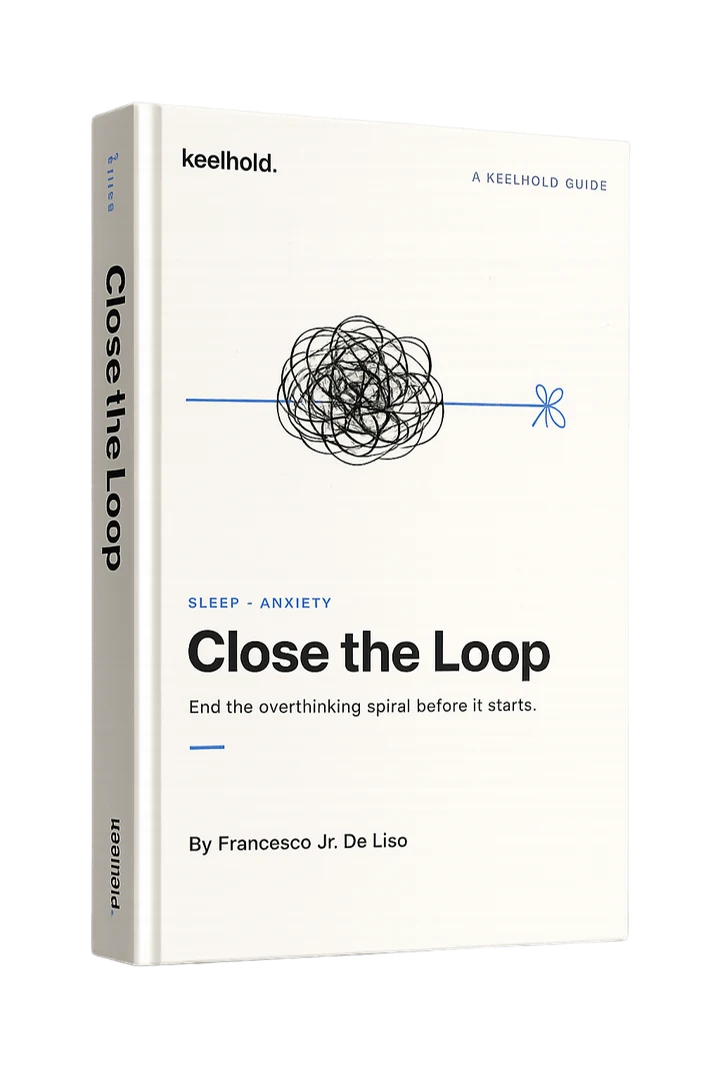
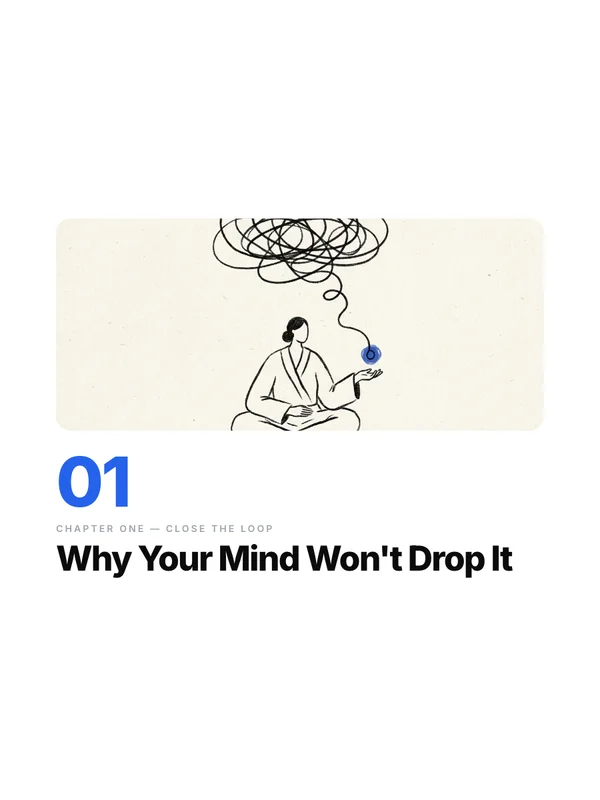
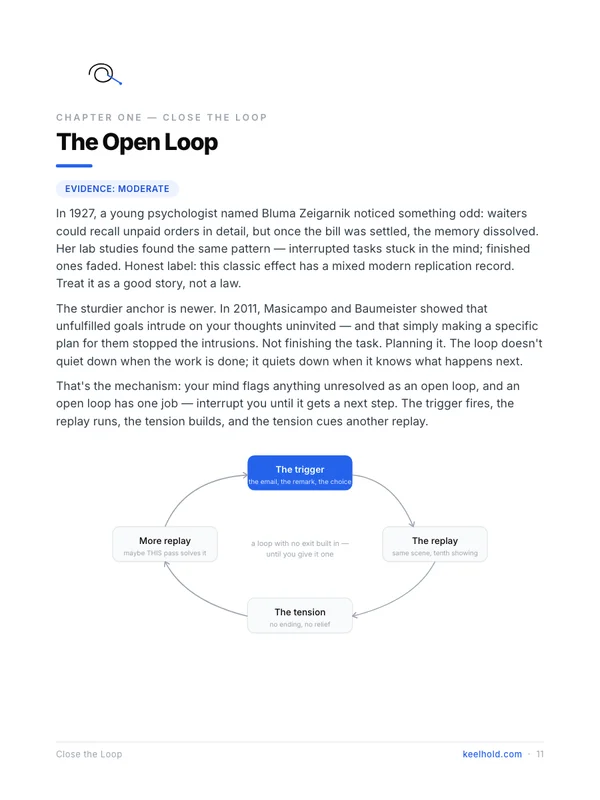
End the overthinking spiral before it starts. You re-read sent emails, replay conversations, rehearse decisions — and it feels like work. It isn't. This short, evidence-graded guide shows you why your mind won't drop things, and hands you four concrete moves that give every loop the one thing it wants: an ending.
Instant PDF — yours foreverSecure checkout (Stripe)Read it in one evening
Is this you?
You've re-read that sent email four times today.
You replay conversations days after everyone else forgot them.
You rehearse discussions that may never happen.
Small decisions take laps: you decide, un-decide, decide again.
Open tasks follow you into the shower, the drive, the pillow.
You've called all this "just being thorough."
If you recognized yourself: this isn't a character flaw. It's a mechanism — a surprisingly well-studied one — and a mechanism can be closed.
The method
Four moves. One routine.
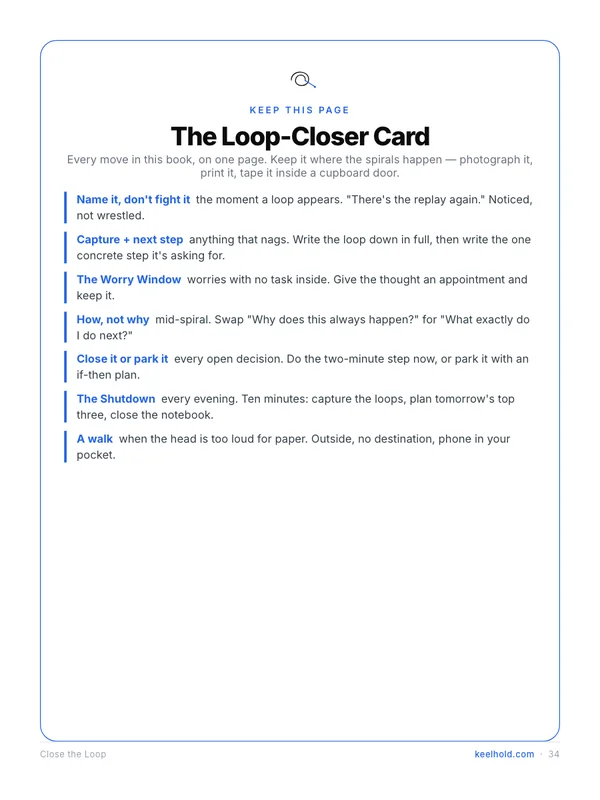
Not "just stop thinking about it" — that's the one move research guarantees will fail. Four concrete moves that work with your mind instead of against it.
1
Capture
Out of your head, onto paper — the loop plus its next concrete step. The plan quiets it, not the finishing.
2
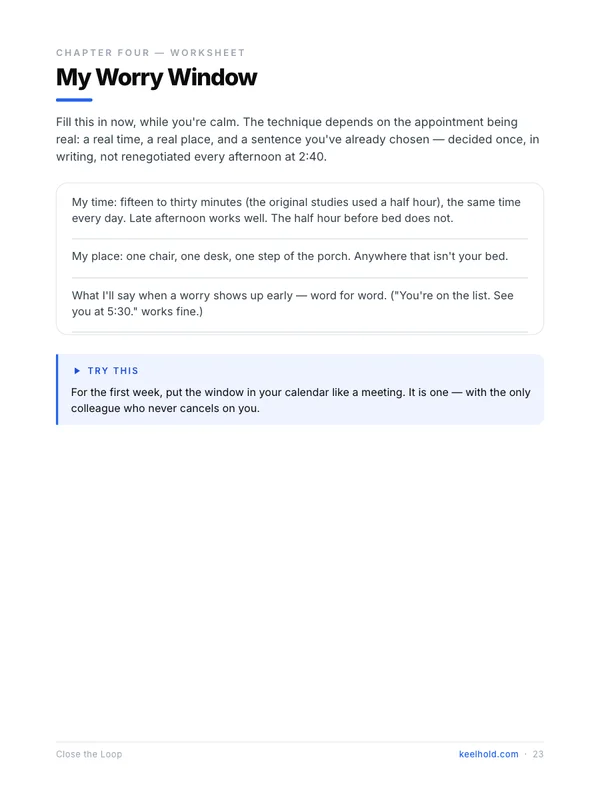
The Worry Window
Worries without a task get an appointment, not an argument. Counterintuitive — and tested.
3
How, Not Why
Swap the spiral question for the question that moves. "Why me?" loops. "What now?" ends.
4
Close or Park
Do the two-minute step now — or park it with an if-then plan. A parked loop stops asking.
The evidence
No hype. Just what holds up.
Every move in this guide is graded against published research — strong, moderate, emerging — with the sources named, so you can check it yourself.
The white bear
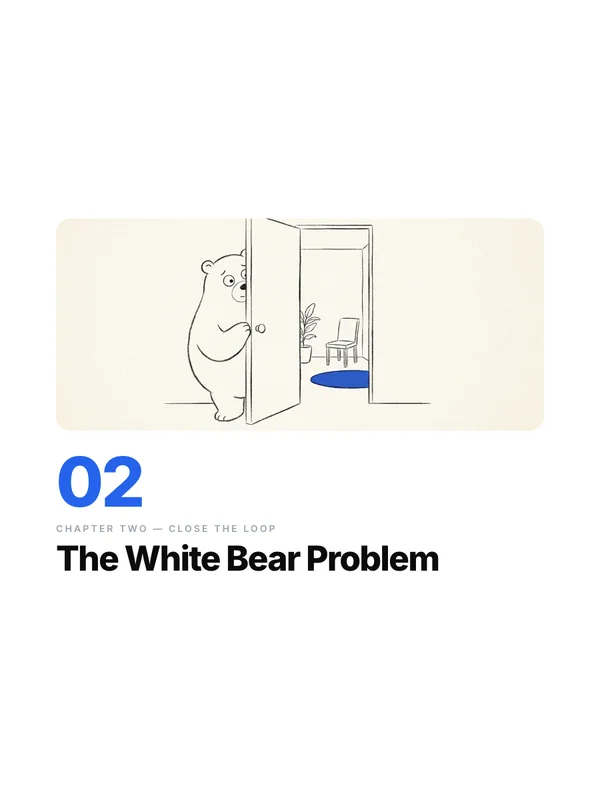
In Wegner's famous experiments, people told NOT to think about a white bear thought about it more — especially afterward. Suppressing a thought reliably backfires; later pooled analyses found the same modest, consistent rebound.
Unfulfilled goals barge into your thoughts uninvited — and in Masicampo & Baumeister's studies, simply making a specific plan for them stopped the intrusions. Not finishing the task. Planning it.
Decades of research by Nolen-Hoeksema and colleagues: turning a problem over and over predicts the onset and worsening of low mood and anxiety — and rarely produces solutions. It feels like work. It isn't.
Across 94 independent studies, "If it's Saturday at 10am, then I'll call the dentist" plans reliably closed the gap between intending and doing — one of the most robust effects in the field.
Borkovec asked chronic worriers to schedule their worry — one fixed half-hour a day, same time, same place — and postpone the rest to it. Daily worry dropped. Later trials support the technique.
Watkins' review of repetitive thought: abstract "why me / what does it mean" processing prolongs the spiral, while concrete "what exactly happened, what's the next step" processing helps you move.
In a small lab study, people who wrote a specific to-do list before bed fell asleep faster than those who journaled about finished tasks. Small sample — promising, honestly labeled.
These studies describe general findings about ordinary overthinking, on average. Close the Loop turns them into practical tools — it's educational, not therapy or medical advice, and results vary from person to person.
What you get
37 pages. Zero filler. Read it tonight.
The full method: why loops run, and the four moves that end them
Three fill-in worksheets: the Loop List, your Worry Window, the If-Then Builder
The 10-minute Evening Shutdown — end the day so it doesn't follow you to bed
The printable Loop-Closer Card — every move on one page
7 diagrams & 8 original illustrations (including one very discreet white bear)
Every claim graded — strong, moderate, emerging — with sources
Look inside
See it before you buy.
Real pages from the guide — the tone, the diagrams, the worksheets. This is the actual book, not a mock-up.
Who wrote this
Francesco Jr. De Liso
“I wrote this book because I'm its target audience — the person who re-reads a sent email as if the words might have shifted since this morning, who replays a conversation on the drive home and again in the shower. Close the Loop is the book I needed on an ordinary Tuesday, somewhere around the fourth re-read. I'm not a psychologist or a therapist: I read the actual research, checked every claim against the original studies, and graded the evidence honestly. You'll never have to guess which is which.”
Questions
Good to know
Is this therapy or medical advice?
No. Close the Loop is general education about ordinary overthinking — the kind that eats your evenings, not the kind that takes over a life. It is not therapy, diagnosis, or treatment for anxiety disorders, OCD, or depression. If rumination or worry is severely affecting your life, a qualified professional can do more than any book — and the guide says so plainly.
How is this different from The 3AM Protocol?
They're siblings. The 3AM Protocol is for the middle of the night — what to do when you're already awake and spiraling. Close the Loop works upstream: it closes the open loops during the day and shuts the day down properly, so fewer spirals reach your pillow in the first place.
What format is it — can I read it on my phone?
It's a PDF that opens on any phone, tablet or computer — no app needed. It's 37 pages by design: you can read it in one evening, and the one-page Loop-Closer Card at the back is made to keep.
Is this a one-time payment?
Yes — a single $19 purchase. No subscription, no recurring charges. The guide is yours to keep for good.
Will it stop me overthinking forever?
No book can honestly promise that — so this one doesn't. What it gives you is a mechanism you can finally see, and four concrete moves that close loops one by one. With use, the moves become reflexes.
Can I get a refund?
Because it's an instant digital download that's yours the moment you buy, all sales are final. If you ever have trouble accessing your file, email hello@keelhold.com and we'll make it right.
Give the loop an ending.
Get Close the Loop now — instant PDF, read it tonight, run the shutdown tomorrow evening.