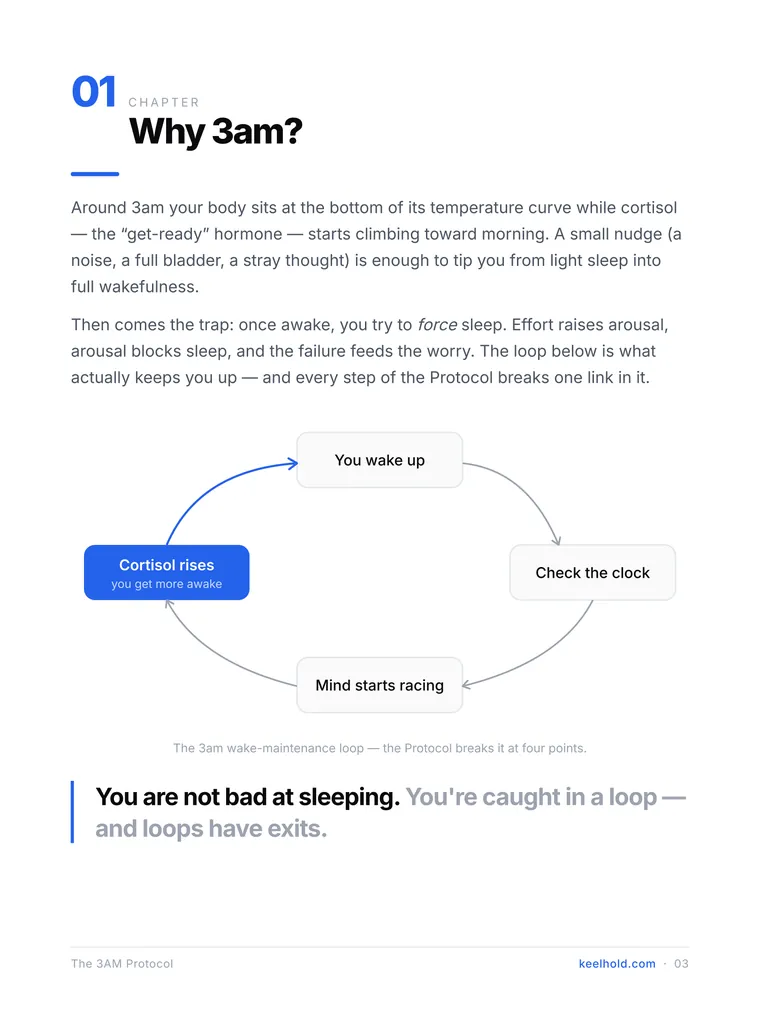
Cortisol follows a circadian rhythm that reaches its lowest point around midnight and begins rising in the second half of the night, so that levels are climbing in the pre-dawn and early-morning hours around the time people wake.
Strong evidenceShut off a racing mind and fall back asleep — in under 20 minutes. No phone, no clock-watching. A calm, step-by-step method for the exact moment your mind wakes before you're ready.
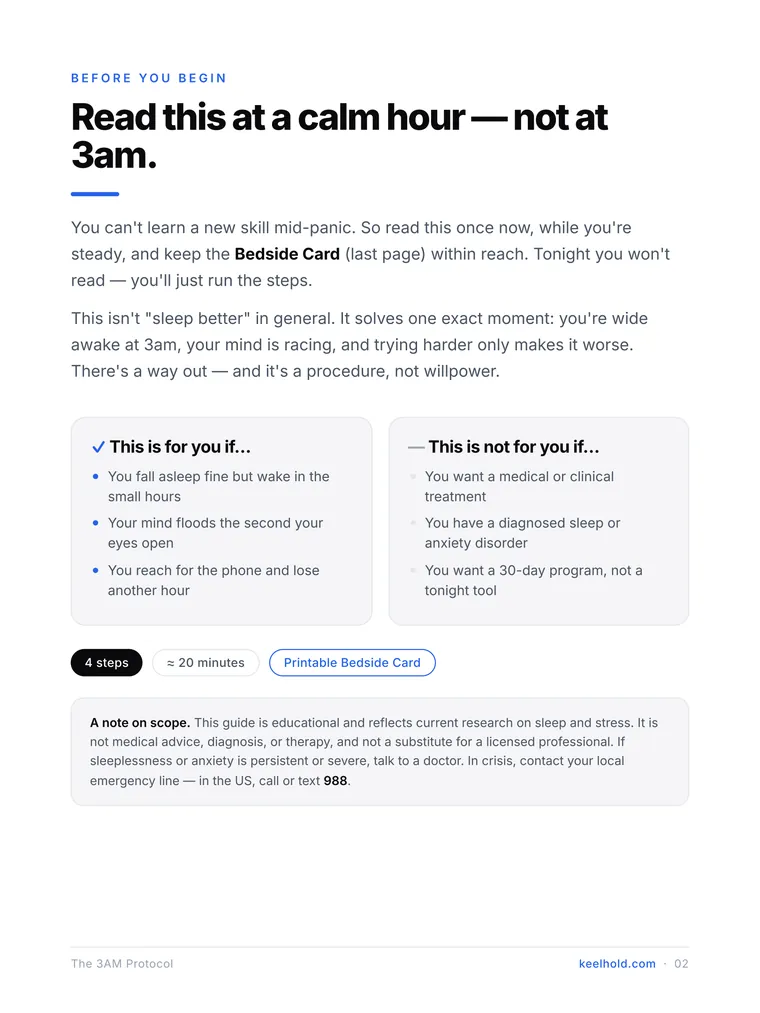
If you recognized yourself, this guide was written for exactly this moment — and it's built to be used in the dark, half-asleep.
Not "relax" or "count sheep." Four concrete moves that break the loop keeping you awake.
Two physiological sighs, then 4-7-8 breathing — the body's own brake.
Name the thought in a word and park it for the morning. Off guard duty.
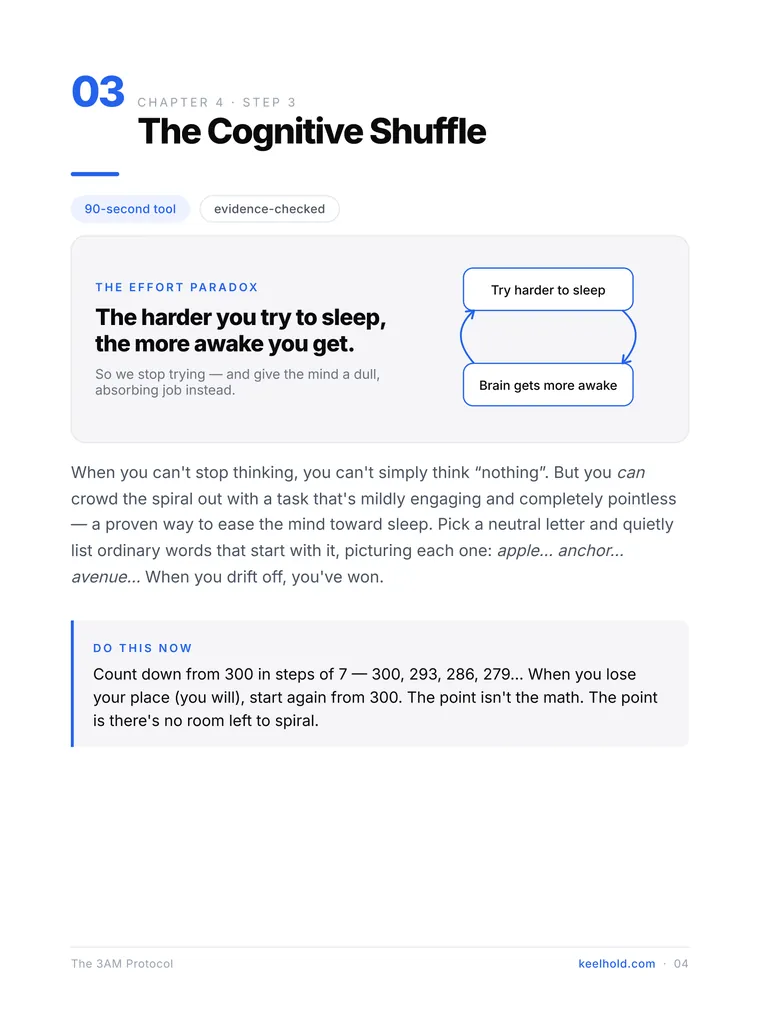
Give the mind a dull, absorbing job that crowds out the spiral.
Still wired? Leave the bed the right way — and protect what it means to sleep.
Every move in the protocol is built on published research. Here's the science it draws on — with the sources, so you can check it yourself.
Cortisol follows a circadian rhythm that reaches its lowest point around midnight and begins rising in the second half of the night, so that levels are climbing in the pre-dawn and early-morning hours around the time people wake.
Strong evidenceTrying too hard to fall asleep and watching the clock are linked to worse insomnia, because the effort and monitoring tend to increase arousal and worry that keep you awake.
Moderate evidenceIn a Stanford randomized controlled trial, five minutes a day of "cyclic sighing" (a double inhale followed by a long exhale) improved mood and lowered breathing rate more than mindfulness meditation, though the study was small and short-term.
Moderate evidenceSlow breathing (fewer than about 10 breaths per minute) is associated with a shift toward parasympathetic "rest-and-digest" activity, including higher heart-rate variability and vagal tone, according to a systematic review of the research.
Moderate evidenceOne small laboratory study suggests that writing a specific to-do list before bed may help people fall asleep somewhat faster, possibly by offloading worries about unfinished tasks.
Emerging evidenceAn emerging technique called "cognitive shuffle" (serial diverse imagining) — deliberately picturing a random, unconnected sequence of neutral images at bedtime — may ease falling asleep by disrupting the coherent, arousing thinking that keeps people awake, though the supporting evidence is still preliminary.
Emerging evidenceStimulus control—getting out of bed if you can't sleep within about 20 minutes and returning only when sleepy, to re-associate the bed with sleep—is a long-established behavioral technique for insomnia and a core component of cognitive behavioral therapy for insomnia (CBT-I) endorsed by the American Academy of Sleep Medicine.
Strong evidenceLeading US clinical guidelines recommend Cognitive Behavioral Therapy for Insomnia (CBT-I) — which includes techniques such as stimulus control, sleep scheduling, and cognitive strategies — as the first-line treatment for chronic insomnia, with medication reserved for cases where CBT-I alone is unsuccessful.
Strong evidenceThese studies describe general findings on sleep, breathing and attention in the wider population. The 3AM Protocol turns them into practical steps — it's educational, not medical advice, and results vary from person to person.
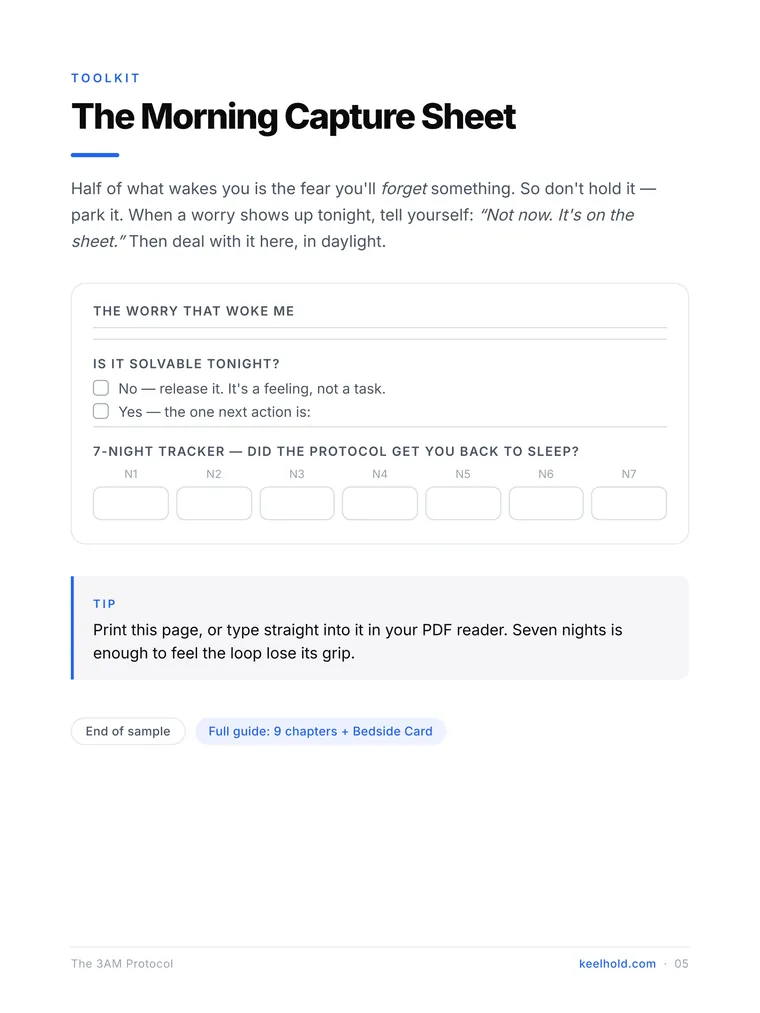
A clear arc: why 3am happens, the four moves you run in the dark, then a 7-night plan to make it automatic.
Real pages from the guide — the design, the tone, the diagrams. This is the actual free sample, not a mock-up.

A lawyer — trained in composure under pressure, not in medicine. “I'm not a doctor or a therapist. I ran these tools on my own 3am wakes for years, tested them against the sleep science, and cut everything that was noise. What's left is a clear set of skills you can actually use in the dark.”
The moment you check out, the guide is yours: download it, read it tonight, and keep it for life on any device. Every method is drawn from published research, with the sources cited.
No. The 3AM Protocol is general wellness education — practical skills drawn from published research on sleep, breathing and attention. It is not medical advice, diagnosis, or treatment, and it isn't a substitute for a professional. If sleeplessness or anxiety is seriously affecting your life, please talk to a doctor.
It's a PDF. It opens on any iPhone, iPad, Android device or computer — no app needed. Save it to your phone and it's there the next time you wake at 3am. The one-page Bedside Card is made to print, too.
It's an instant digital download. Right after checkout you'll get the PDF by email and a download link — ready to read tonight on your phone, tablet or computer.
Yes — a single $19 purchase. No subscription, no recurring charges, no upsell wall. The guide is yours to keep for good.
No. Breathing is only step one. The protocol also gives you a way to park a racing thought, a mental technique that crowds out the spiral, and an exact plan for when you're still awake after 20 minutes — plus a 7-night plan to make it automatic.
The protocol targets the specific 3am wake — a racing mind that won't switch off. It won't cure a diagnosed sleep disorder, but for the ordinary awake-and-spiraling-at-3am it gives you a plan instead of panic — ready to run the very next time 3am hits.
If you have a diagnosed sleep disorder, or your sleeplessness is severe, long-running, or tied to a medical condition, this isn't a substitute for a doctor. It's built for the ordinary 3am wake — a healthy mind that simply won't switch off.
Because The 3AM Protocol is an instant digital download that's yours to keep the moment you buy, all sales are final. If you ever have trouble accessing or opening your file, email hello@keelhold.com and we'll make it right.
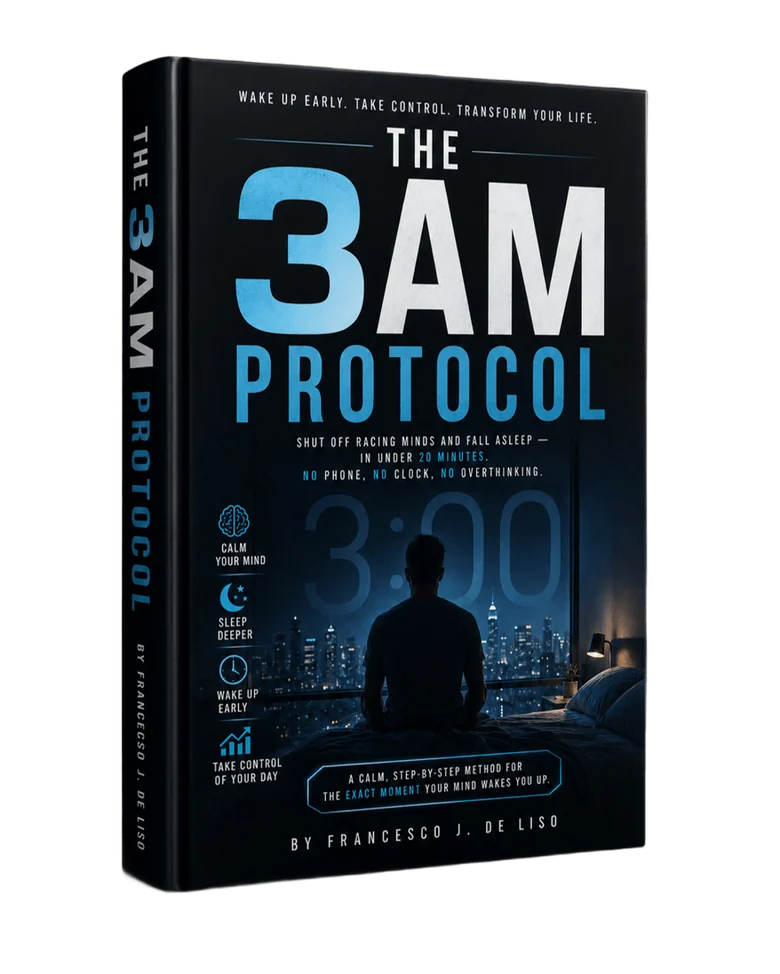
Get The 3AM Protocol now — instant PDF, yours to keep forever, ready for the very next 3am.
Buy now — $19 Read a free sampleSecure checkout with Stripe · Instant download