Anxious minds inflate two numbers at once: how likely the bad thing is, and how bad it would be. Butler & Mathews' classic work found both errors, especially for events about yourself — the mechanism this whole book measures.
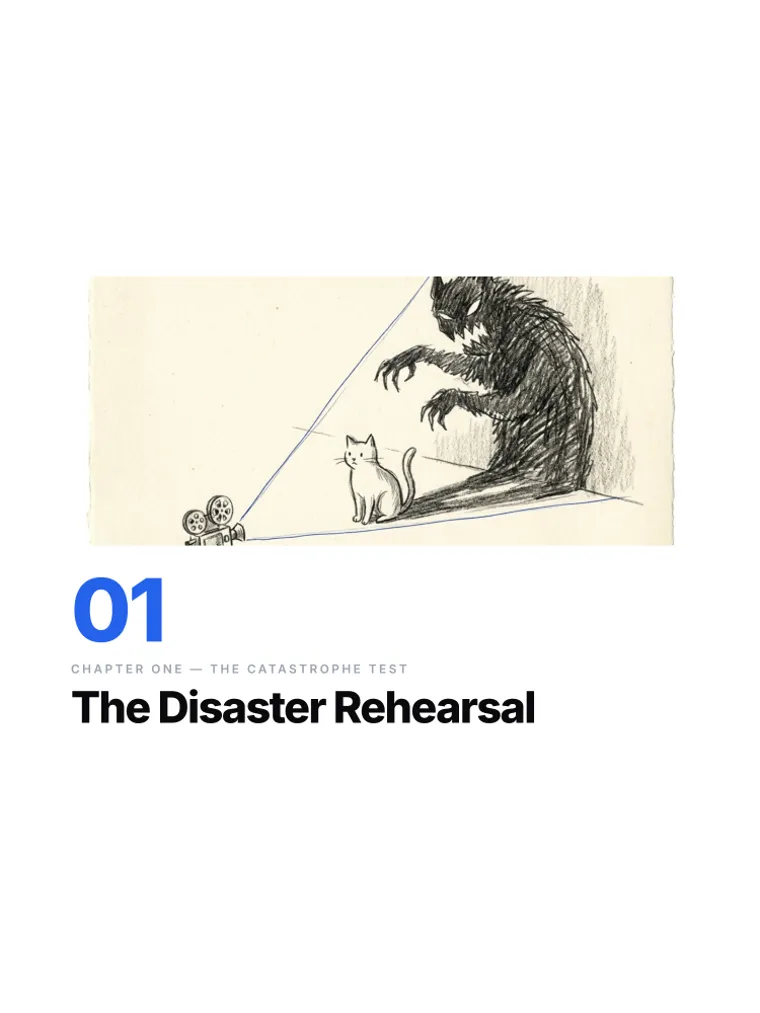
Moderate evidenceThe text says "can we talk tomorrow?" — five words — and ninety seconds later you've been fired, missed the mortgage, and moved back in with your mother. Your mind is a projector: it takes something small and casts a shadow the size of the wall. This evidence-graded guide hands you the measuring tape — five questions that shrink worst-case scenarios back to the size of real life.
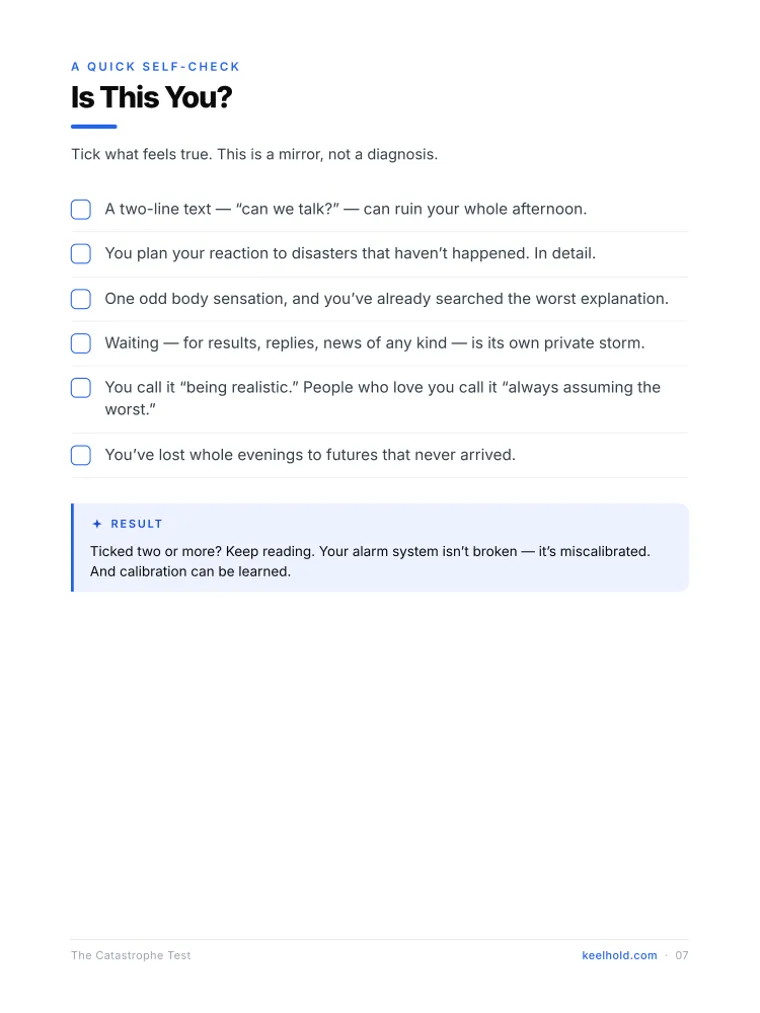
If you recognized yourself: your alarm system isn't broken. It's miscalibrated — and calibration is learnable.
Not positive thinking — positive thinking argues with the shadow, and your mind rightly doesn't believe it. The Test measures instead: it asks the shadow for its dimensions and writes them down.
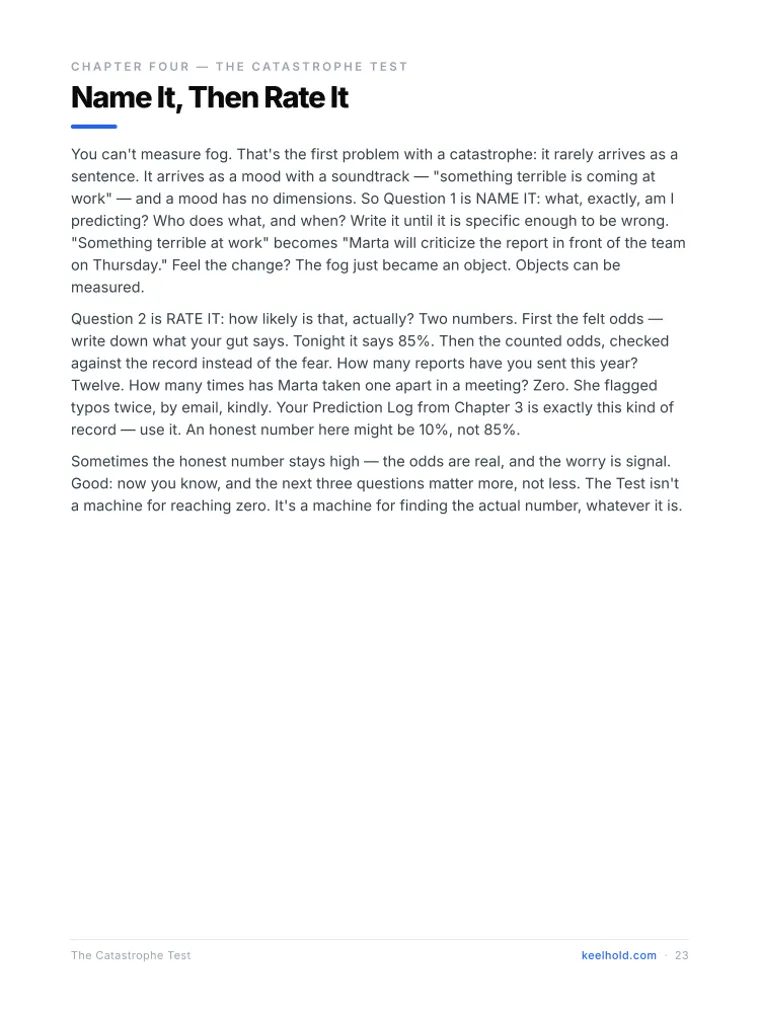
What exactly am I predicting? Vague dread can't be measured — one specific sentence can.
Felt odds vs honest odds — checked against your track record, not your fear.
If it happened: how bad, 0–10 — and how long until life is 80% normal again?
Your first three moves if it actually happened. The cope plan, in ink.
The most likely outcome, written next to the worst case — plus one step you control today.
If the alarm survives the Test, it's a signal: one real move beats another showing of the film.
Every move in this guide is graded against published research — strong, moderate, emerging — with the sources named, so you can check it yourself.
Anxious minds inflate two numbers at once: how likely the bad thing is, and how bad it would be. Butler & Mathews' classic work found both errors, especially for events about yourself — the mechanism this whole book measures.
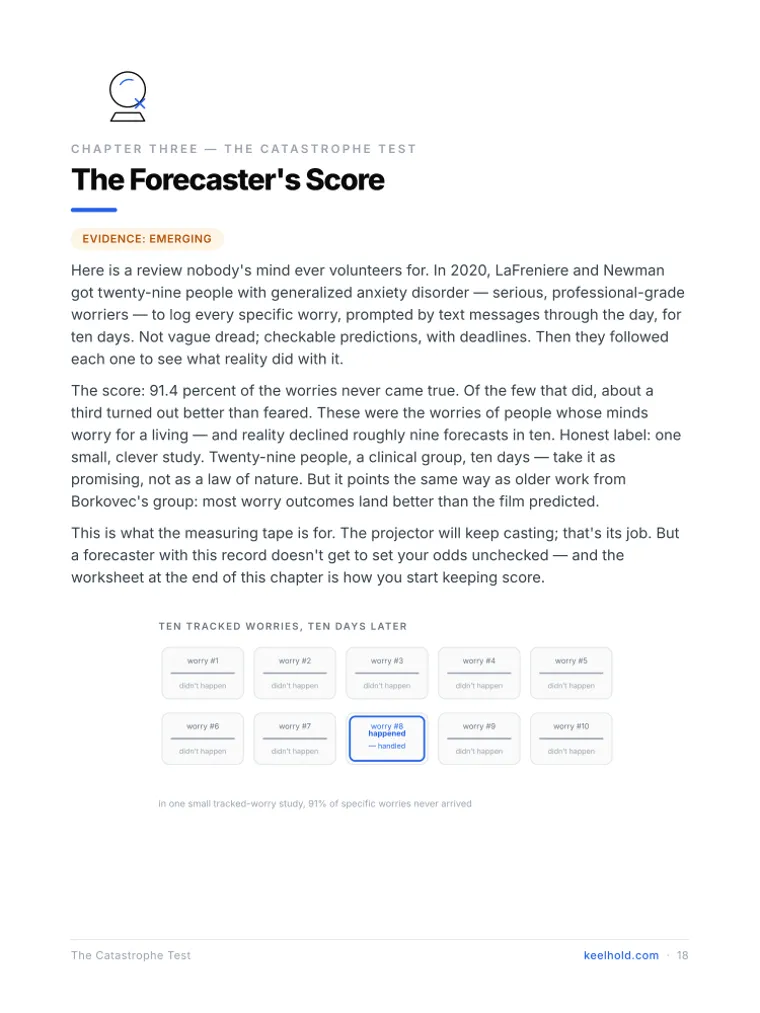
Moderate evidencePeople with clinical-grade worry tracked every specific worry for ten days: 91.4% never came true, and of the few that did, about a third went better than expected. One small, clever study — labeled honestly in the book.
Emerging evidenceGilbert and colleagues asked people to forecast their misery after real blows — breakups, lost elections, career setbacks. Forecasts were wrong in one direction: the pain was sharper but far shorter than predicted. The forecast keeps leaving out you, coping.
Strong evidenceThe Test adapts decatastrophizing — naming the feared outcome, checking its odds, checking your coping — a core move of cognitive behavioral therapy, the best-tested talk approach for anxious thinking in a review of over 100 meta-analyses.
Strong evidenceDugas and colleagues found that intolerance of uncertainty — the unbearable itch of not knowing — is a central engine of chronic worry. Googling, checking and reassurance buy minutes of relief and keep the engine running.
Moderate evidenceExplaining an outcome as if it had already happened — "prospective hindsight" — generated about 30% more specific reasons in a lab task. It's the trick behind the premortem: deliberate worst-case work that ends in a plan, not a spiral.
Emerging evidenceNorem & Cantor studied "defensive pessimists" — anxious people who deliberately rehearse specific setbacks in order to plan for them. They perform as well as optimists; block the strategy, and performance drops. Worst-case thinking done well is a tool.
Moderate evidenceWhen people reframed a pounding heart as the body fueling performance — not failing — their cardiovascular response shifted toward challenge and their attention held steadier under stress. A small experimental literature, honestly labeled.
Emerging evidenceThese studies describe general findings about ordinary worst-case thinking, on average. The Catastrophe Test turns them into practical tools — it's educational, not therapy or medical advice, and results vary from person to person.
Real pages from the guide — the tone, the diagrams, the worksheets. This is the actual book, not a mock-up.

“I wrote this book because I'm its target audience — the person whose mind takes a two-line text and produces a full disaster film, with sequels, and a director's cut that screens at 3am. The Catastrophe Test is the book I needed in an airport chair, waiting on a phone call that was forty minutes late. I'm not a psychologist or a therapist: I read the actual research, checked every claim against the original studies, and graded the evidence honestly. You'll never have to guess which is which.”
No. The Catastrophe Test is general education about ordinary worst-case thinking — the kind that eats your evenings, not the kind that takes over a life. It is not therapy, diagnosis, or treatment for anxiety disorders, panic, or health anxiety. If catastrophic thinking is constant, physical, or running your life, a qualified professional can do more than any book — and the guide says so plainly, with real resources listed.
No — it's measuring. Positive thinking argues with the shadow ("it'll be fine!") and your mind, quite rightly, doesn't believe it. The Test asks the worst-case thought for its dimensions: how likely, how bad, for how long, and what you'd actually do. Sometimes the measurement says the worry is real — and then the book tells you to act, not relax.
They're siblings. Close the Loop is for the replay spiral — re-reading sent emails, replaying conversations. The 3AM Protocol is for the middle of the night. The Catastrophe Test is for the mind that jumps to the worst case: the "can we talk?" text, the odd freckle, the turbulence. Different engine, different tool.
It's a PDF that opens on any phone, tablet or computer — no app needed. It's 52 pages, rich with diagrams and worksheets, and the one-page Test Card at the back is made to keep.
Yes — a single $19 purchase. No subscription, no recurring charges. The guide is yours to keep for good.
Because it's an instant digital download that's yours the moment you buy, all sales are final. If you ever have trouble accessing your file, email hello@keelhold.com and we'll make it right.
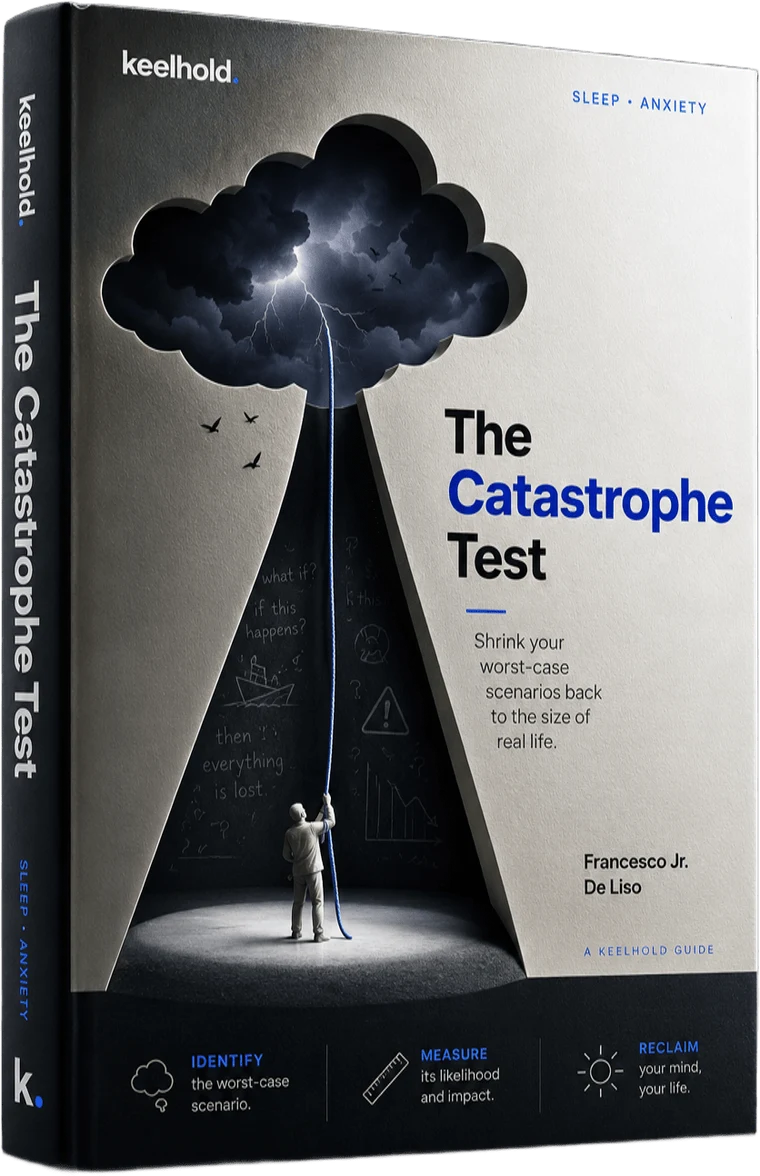
Get The Catastrophe Test now — instant PDF, read it tonight, run your first Test on tomorrow's worry.
Buy now — $19Secure checkout with Stripe · Instant download