How to recognize manipulation, love bombing, and the men who weaponize attention. Every genuinely dangerous man was charming first — this is how to tell real warmth from charm used as a tool, before you've lost the ability to see clearly.
If you recognized yourself: you are probably not too sensitive, too much, or imagining it. This guide helps you see the pattern clearly — and trust your own eyes again.
The issue was never the charm. It's whether the charm is a genuine expression of who he is — or a tool being used to get something (access, control, admiration) before you've had time to see clearly. Most charming men are just charming men. This guide teaches you to tell the two apart — early, and without losing your ability to trust good people.
Not a checklist that makes you suspicious of everyone. A clear way to name the specific moves — and turn recognition into a plan.
Love bombing, the fast-forward, gaslighting, the hot-and-cold hook, blame-shifting — seen as patterns, not isolated bad days.
Why these patterns are so hard to see from the inside, and why leaving can feel impossible. It's mechanics — not weakness.
Rebuild trust in your own memory and perception — the exact thing these dynamics are designed to erode.
Boundaries, distance and safety, plus a staged Clarity & Safety Plan you can move through at your own pace.
This isn't an argument that kindness is a red flag or that every man who likes you quickly is a predator. It's a careful guide to one distinction — written by a man handing you the outside view.
How this particular charm is performed — the speed, the mirroring, the flood — is easier to spot from outside. That's what you're handed here.
No armchair labels. It describes observable behaviors and their effect on you — what you can know, and what you can't.
Wherever a step could raise risk, there's a safety note. Recognition is powerful; a plan is what keeps you safe.
Direct where directness protects you, gentle where the subject is raw. Written to be read even while you're still in it.
This is a work of honest observation and opinion — educational, not therapy, medicine, law, or a diagnosis of anyone. If any part of your situation feels unsafe, treat your safety as the priority and reach out to a qualified professional or a domestic-abuse support service.
Ten short chapters, each one a tool — plus a staged plan and a closing you'll want to reread.
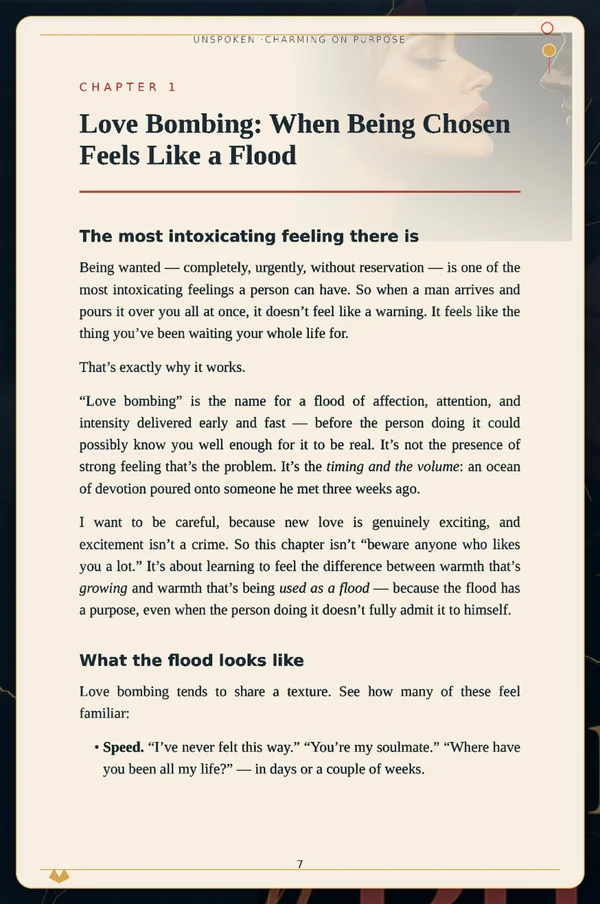
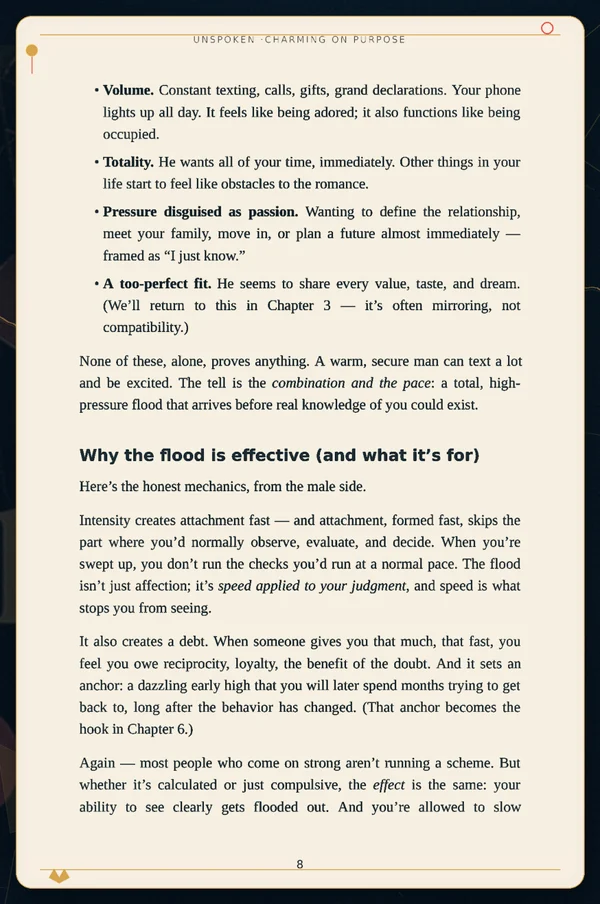
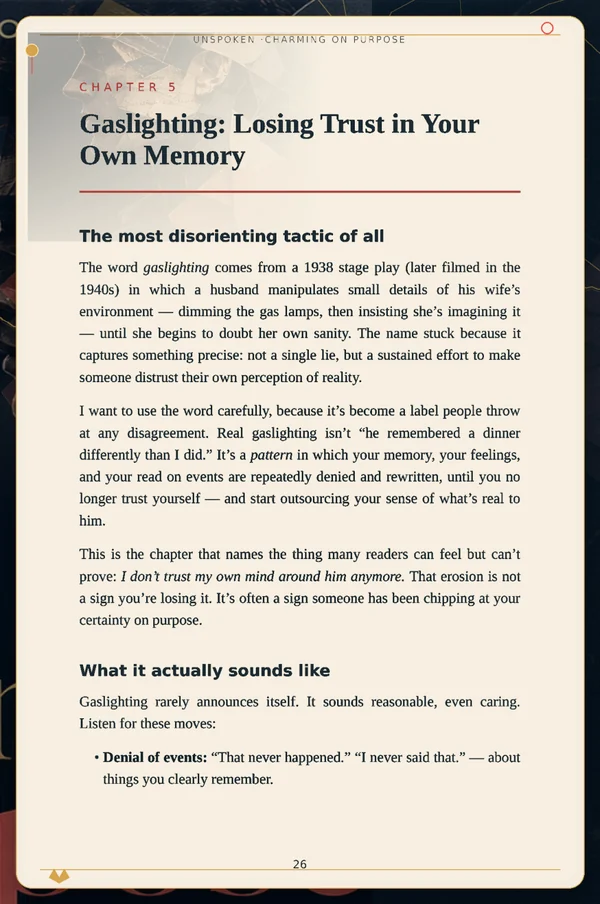
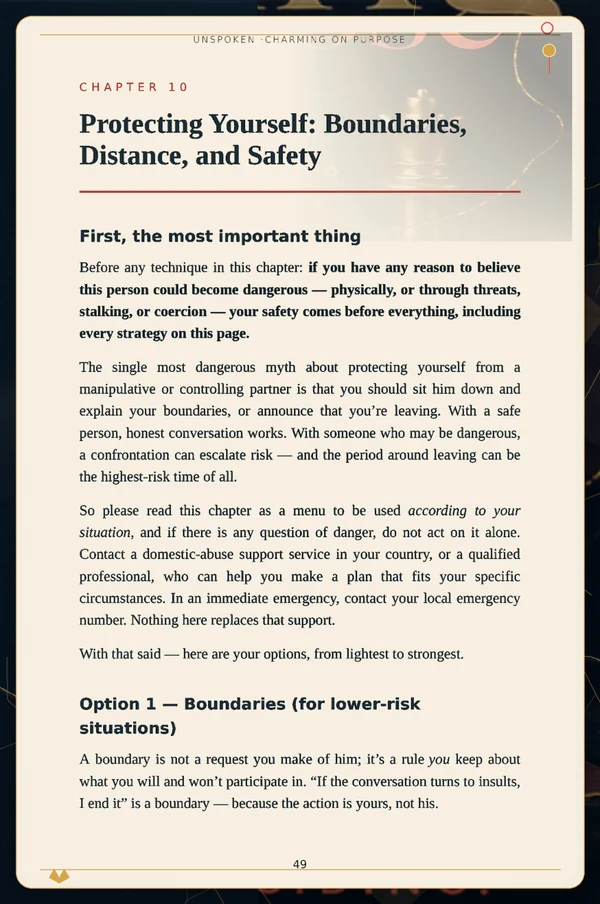
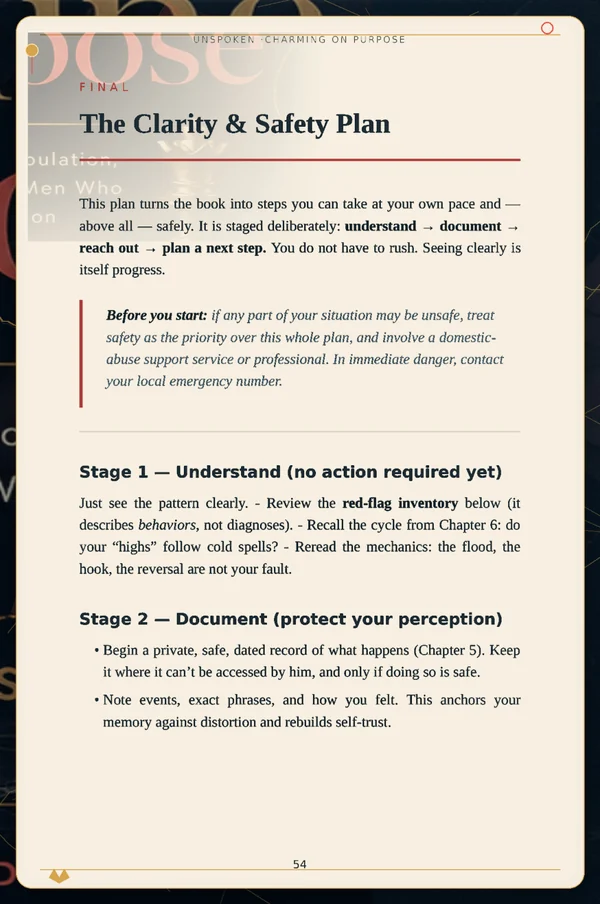
Real pages from the guide — the tone, the chapters, the safety notes, the plan. This is the actual book, not a mock-up.
If there is manipulation, control, or threat in your relationship, your safety comes before anything in these pages. In the US, the National Domestic Violence Hotline is free, confidential and open 24/7: call 1-800-799-7233 or text START to 88788 (thehotline.org). In immediate danger, call 911. In emotional crisis, call or text 988. You don't have to be certain, or explain it perfectly, to deserve support.

“I'm a man, writing to a woman about how some men operate. I don't do it to speak for all men — I can't, and the ones who do are usually selling something. I do it because I've watched, up close and from a distance, how this particular kind of charm is performed: the speed, the mirroring, the flood of attention that feels like destiny and functions like a strategy.”
“It's easier to spot from the outside. I'm just handing you the outside view — gentle where this is tender, direct where directness protects you. If I ever sound like I'm minimizing what you've lived, I'm not. I believe you.”
No — and if you finish the book suspicious of every warm gesture, it will have failed you. Most charming men are just charming men. The book is about one distinction: whether the charm is a genuine expression of who he is, or a tool used to get something before you can see clearly.
No. It can't diagnose anyone, and it won't try. It teaches you to recognize observable behaviors — love bombing, gaslighting, the hot-and-cold hook — and understand their effect on you, so you can make clear, safe decisions. Labels are for professionals; clarity is for you.
No. It's a work of honest observation and opinion — educational, not therapy, medicine, or law, and not a substitute for any of them. It includes a full page of crisis resources and tells you clearly when to reach out for qualified help.
Yes — the book is written to be read even while you're still in it, and it opens with a note on keeping your copy and any notes private. Wherever a step could raise risk, there's a safety note. You don't have to act today; seeing clearly is itself a step.
Yes — a single $24 purchase, no subscription. The guide is yours to keep for good.
Because it's an instant digital download that's yours the moment you buy, all sales are final. If you ever have trouble accessing your file, email hello@keelhold.com and we'll make it right.
Get the guide now — instant PDF, yours to keep forever.
Buy now — $24 Read a free sampleSecure checkout with Stripe · Instant download