100% free  ·  No card, no trial  ·  Instant PDF download
Get the free guide
100% free 14 pages 15-minute read Science, not guesswork

Is it love — or love-bombing?

When it's too good, too fast, a quiet part of you already notices. This free guide gives you the 9 early signs the fairytale is really a fast-forward — and five honest moves to slow it down before you lose yourself in it.
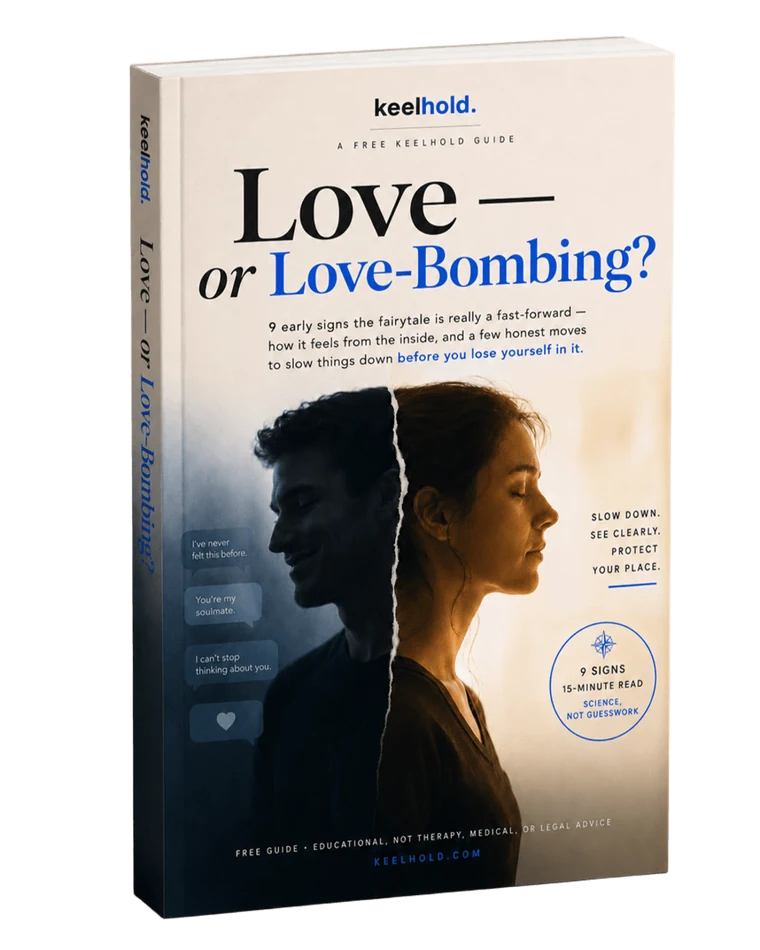
Love — or Love-Bombing? A free Keelhold guide

Free PDF, instant download — no payment, no catch. Unsubscribe anytime.

Lands in your inbox instantly Yours to keep forever No spam, one click to leave
Every claim graded against research Reads in 15 minutes Works on any device Written by Francesco Jr. De Liso
What's inside

Fourteen pages that give the thing a name.

Not a listicle. A map you can hold up against your own last three weeks.

9

The early signs

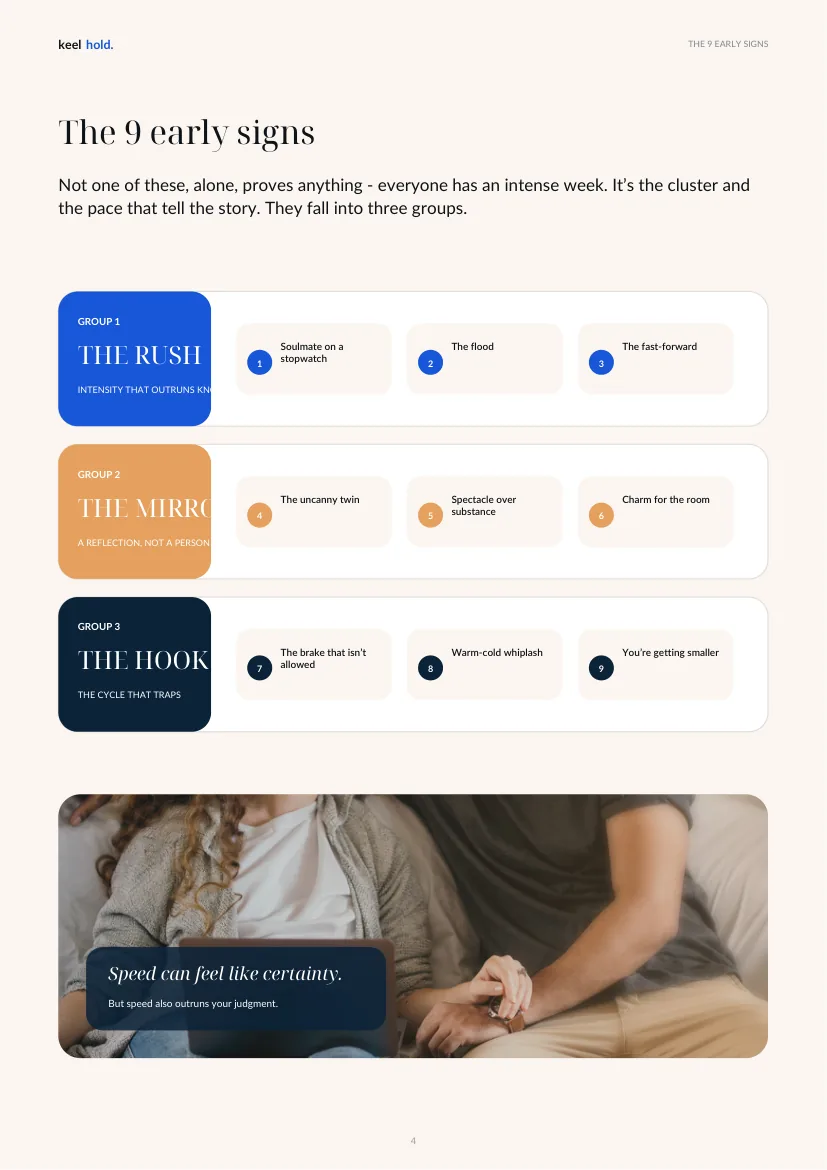
Grouped into the rush, the mirror and the hook — so you see a pattern, not a pile of red flags.

1

The tell

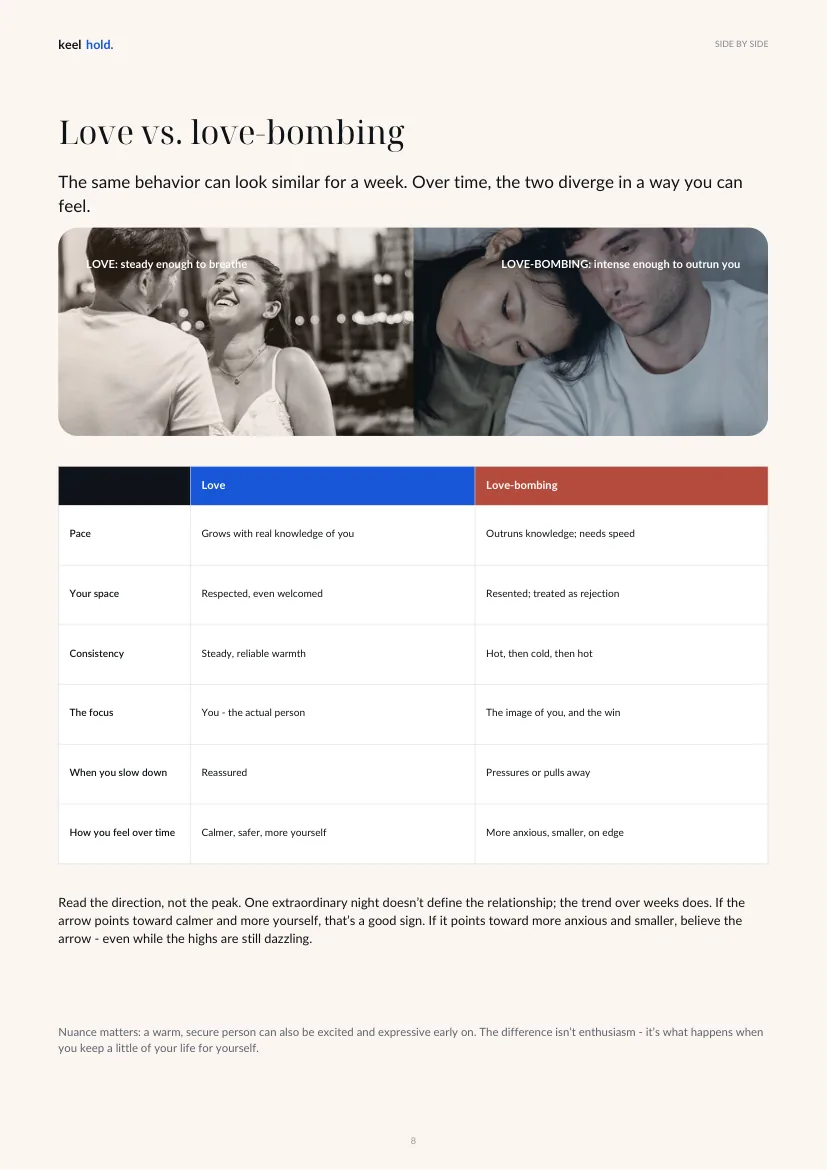
Love and love-bombing side by side, and the single question that separates them.

5

Moves that work

What to actually do this week — small, safe, and designed to give you evidence.

A self-check

Nine boxes, honest scoring, and safety resources if the answer is heavier than expected.

Look inside

Designed like a book, not a bonus PDF.

The 9 early signs, grouped
The nine signs, grouped into three patterns you can actually remember.
Love vs. love-bombing side by side
Love vs. love-bombing, line by line — pace, space, consistency, focus.
Five moves to see clearly
Five moves that create time, evidence and support — the things intensity removes.
Read this first

Being hooked isn't a verdict on your intelligence.

Every genuinely harmful relationship was charming first. Not because charm is bad — because charm is how the door gets opened. Love-bombing is charm poured on faster than real knowledge of you could possibly justify, and the speed is the point: it outruns your judgment before you've had time to see clearly.

A reward that arrives unpredictably grips the mind harder than one that arrives reliably.

That's not a flaw in you — it's the same mechanism that makes a slot machine compulsive and a vending machine boring. Once you can name the pattern, it starts to lose its grip. The guide hands you the shape.

Francesco Jr. De Liso
Who wrote it
“I'm a man — not a therapist. That's exactly why I can show you the other side of the glass.”

I write about how men actually think when they want something — and what it looks like when attention is being used as a tool instead of offered freely. Not to teach you how to control anyone. To help you see clearly, and choose yourself.

Francesco Jr. De Liso 6 guides published Sources in every guide
Before you type your email

Fair questions.

Is it really free?

Yes. No card, no trial, nothing to cancel. You get the full 14-page PDF the moment you sign up.

What happens to my email?

It goes on the Keelhold list so I can send you the guide and, now and then, something worth reading. One click unsubscribes you, and I never share or sell your address.

Is this about diagnosing him?

No. The guide describes behaviour and patterns — it doesn't diagnose anyone, and it isn't therapy or legal advice. It's here to help you trust your own observations again.

What if my situation feels unsafe?

Then that comes first, before any reading. In the US you can call 1-800-799-7233, 24/7, or your local emergency number. The guide includes resources on this too.

Last thing

Get the guide. Then decide with your eyes open.

Educational content — not therapy, medical, or legal advice. In a crisis, in the US call or text 988.